




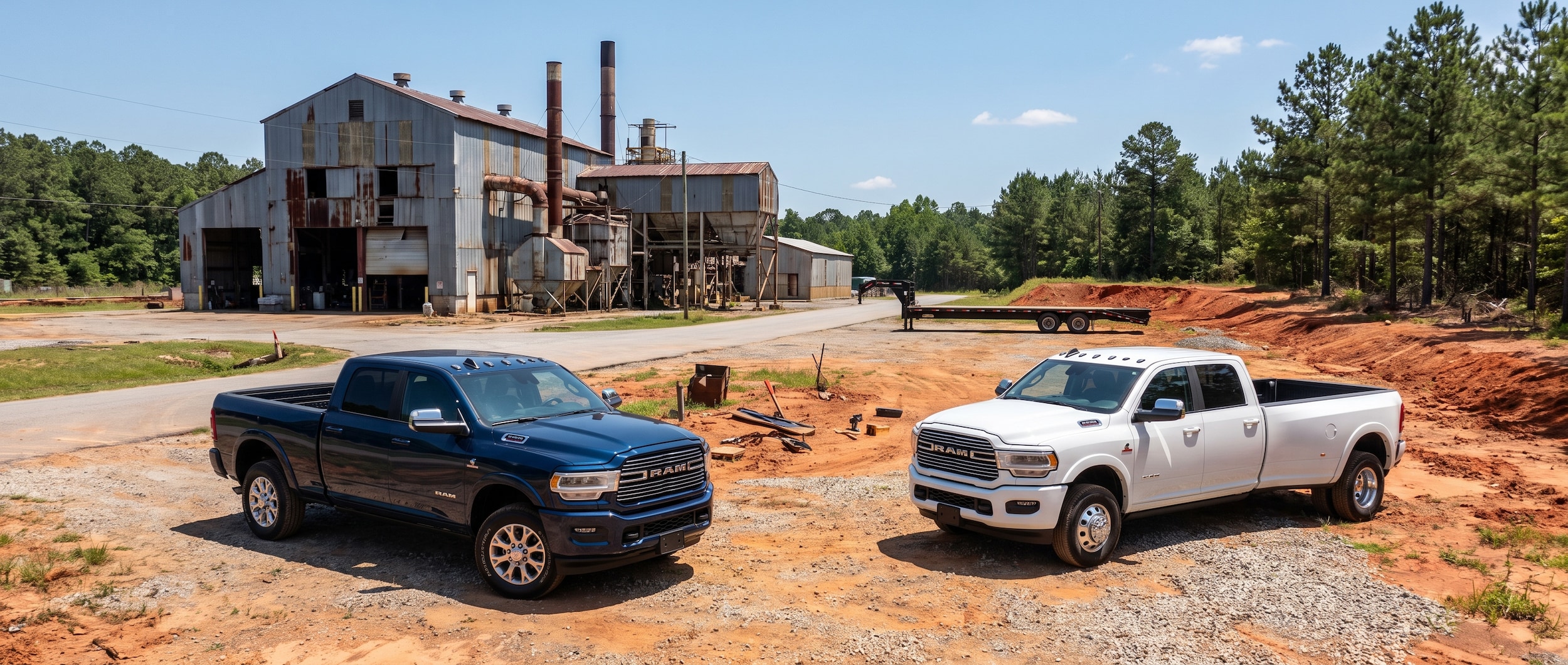
If you're running a crew out of the Jefferson Metropolitan Industrial Park or chasing the construction boom along Old Tuscaloosa Highway, you need a truck that earns its paycheck every day. For most McCalla work crews the Ram 2500 is the right truck, but the Ram 3500 is non-negotiable if you're regularly pulling trailers past the 20,000-pound mark or need a dually for extreme load stability.
- The Ram 2500 handles up to 3,930 lbs of payload (HEMI gas) and tows up to 20,000 lbs with the Cummins diesel. For most work crews, that's more than enough.
- The Ram 3500 unlocks up to 7,590 lbs of payload (HEMI gas) and 36,610 lbs of towing (Cummins diesel, gooseneck). It's the choice when loads get extreme.
- Ride comfort splits the two. The 2500 rides on a coil-link rear suspension that's smoother daily, and the 3500 runs leaf springs, stiffer unloaded but more stable under gooseneck and dually duty.
- McCalla's road improvement projects on McAshan Drive and Bell Hill Road mean rough, active construction corridors right now. The 2500's ride quality matters on those corridors.
- Payload and tow ratings vary by cab, bed, drivetrain, and axle ratio. The sticker on the door jamb is your real number.
What's the real difference between these two trucks?
Both trucks share the same cab styles, engines, and 8-speed transmission, so on paper they're near-twins, but the Ram 3500 separates itself with a reinforced frame, heavier-duty axles, a higher GVWR (up to 14,000 lbs versus the 2500's ceiling near 11,040 lbs), and a GCWR that tops out at 45,000 lbs. It also unlocks the dually (dual rear wheel) configuration, which the 2500 simply does not offer.
The suspension split is the part buyers miss. Ram's 2500 runs a class-exclusive coil-link rear suspension, and the 3500 uses traditional leaf springs. Coil springs stay softer and more compliant on rough pavement when the bed is empty. Leaf springs carry higher loads with less sag, and they're what makes a dually build structurally viable. The 3500 needs them.
| Spec | Ram 2500 (2026) | Ram 3500 (2026) |
|---|---|---|
| Rear suspension | Coil-link (class-exclusive) | Leaf spring |
| Max payload (HEMI gas) | Up to 3,930 lbs | Up to 7,590 lbs |
| Max payload (Cummins HO diesel) | Up to 3,600 lbs | Up to 6,050 lbs |
| Max tow (HEMI gas) | Up to 17,750 lbs | Up to 18,150 lbs |
| Max tow (Cummins HO diesel) | Up to 20,000 lbs | Up to 36,610 lbs |
| GVWR ceiling | ~11,040 lbs | Up to 14,000 lbs |
| GCWR ceiling | ~27,000 lbs | Up to 45,000 lbs |
| Dually option | No | Yes |
| Wheel config | SRW only | SRW or DRW |
Does payload actually matter more than tow capacity for a work crew?
For most McCalla crews, yes, payload matters more than tow capacity, even though the tow ratings are the numbers that dominate the advertising and win the spec-sheet arguments at the counter. The figure that actually bites you on a job site is payload, and that's everything in the bed plus every person in the cab plus your fuel.
A crew of four adults accounts for roughly 700-800 lbs before a single tool goes in the bed. Add a generator, a compressor, or a load of lumber and that 3,930-lb ceiling on the Ram 2500 starts to look like a real constraint you'll feel on certain configurations.
The Ram 2500 is the sensible pick for a crew hauling tools and moderate bed loads while you're pulling a trailer in the 10,000-to-15,000-lb range. That covers most light construction, landscaping, and utility work along the roads between Bessemer and the McCalla industrial corridor.
The Ram 3500 is the truck to choose when you need a HEMI-equipped rig with nearly double that payload headroom, or when you're pulling anything over 20,000 lbs. Ram lists the conventional receiver tongue-weight limit on the 3500 at 2,300 lbs versus 2,000 lbs on the 2500. Small difference on paper, real difference when you're backing a loaded equipment trailer into a tight bay at a McCalla distribution site.
Browse our current Ram heavy-duty inventory to see which configurations and bed/cab combos we've got on the lot.
Ride quality on a real work commute
Ride quality matters more than the spec sheets suggest, and you'll feel it on the daily drive, where the 2500 wins for comfort and the 3500 trades some of that comfort for load control, a split that fuels the Reddit and forum debates repeated across Ram owner communities.
On empty runs, the Ram 2500's coil-link rear suspension is genuinely smoother. Jefferson County is rebuilding McAshan Drive and Bell Hill Road in and around McCalla. That means rougher pavement on daily runs, not just at the job site. A stiffer suspension you're fighting unloaded for 45 minutes each way gets old fast.
The Ram 3500's leaf springs carry heavy loads with less squat and more predictability under extreme weight, especially if you spec a dually. It's not miserable. But unloaded, the 3500 SRW with leaf springs rides firmer than the 2500 with coils. If your crew has any kind of highway commute to the site, that difference is felt by everyone in the cab, not just the driver. Everyone feels it.
So which should your work crew actually pick?
The right pick comes down to two numbers on your daily workload, how much goes in the bed and what you're pulling, so the 2500 answers for most crews while the 3500 earns its keep once your loads climb past what the 2500 can safely carry.
Pick the Ram 2500 if:
- Your heaviest trailer stays under 18,000-20,000 lbs
- Payload of up to 3,930 lbs covers your bed loads with margin left
- Your crew commutes daily and values a more compliant ride on rough roads
- You're running a single truck and need it to double as a comfortable daily driver between job sites
Pick the Ram 3500 if:
- You're regularly pulling gooseneck or fifth-wheel trailers over 20,000 lbs
- Your bed loads routinely push or exceed what the 2500 can safely carry
- You need the dually (DRW) configuration for load stability on equipment-heavy hauls
- You're operating in a fleet context where maximum rated capacity matters for compliance
The honest tradeoff with the 3500 is the unloaded ride and the leaf-spring feel on a half-empty commute. That's not a dealbreaker for a crew running heavy all day. For the crew that's at 60-70% capacity most of the time, the 2500 delivers more truck per daily mile.
See the Ram 3500 configurations available and compare them against your actual payload and tow requirements before you're ready to decide.
Frequently Asked Questions
Will I need a CDL to operate a Ram 3500 for work?
Not in most cases for private, non-commercial operation. A CDL is generally required when the gross combined weight rating (GCWR) of the vehicle and trailer exceeds 26,001 lbs and the vehicle is operated for commercial purposes, or when transporting hazardous materials requiring placards. The Ram 3500's GCWR can reach 45,000 lbs when fully equipped, so commercial operators pulling heavy loads should verify their specific configuration, intended use, and Alabama state licensing requirements with a qualified authority before putting the truck to work.
Can the Ram 2500 handle a gooseneck trailer?
Yes, with conditions. Ram specifies that a 5th-wheel or gooseneck hitch is required for the Ram 2500 on trailers exceeding 20,000 lbs. The Ram 2500 with the Cummins High-Output diesel is rated to tow up to 20,000 lbs on certain configurations. That ceiling is firm. If your gooseneck trailer loaded regularly exceeds that figure, the Ram 3500 is the appropriate truck. For trailers running under 20,000 lbs, the Ram 2500 with a proper gooseneck hitch and the Cummins diesel is a capable and more comfortable daily option.