





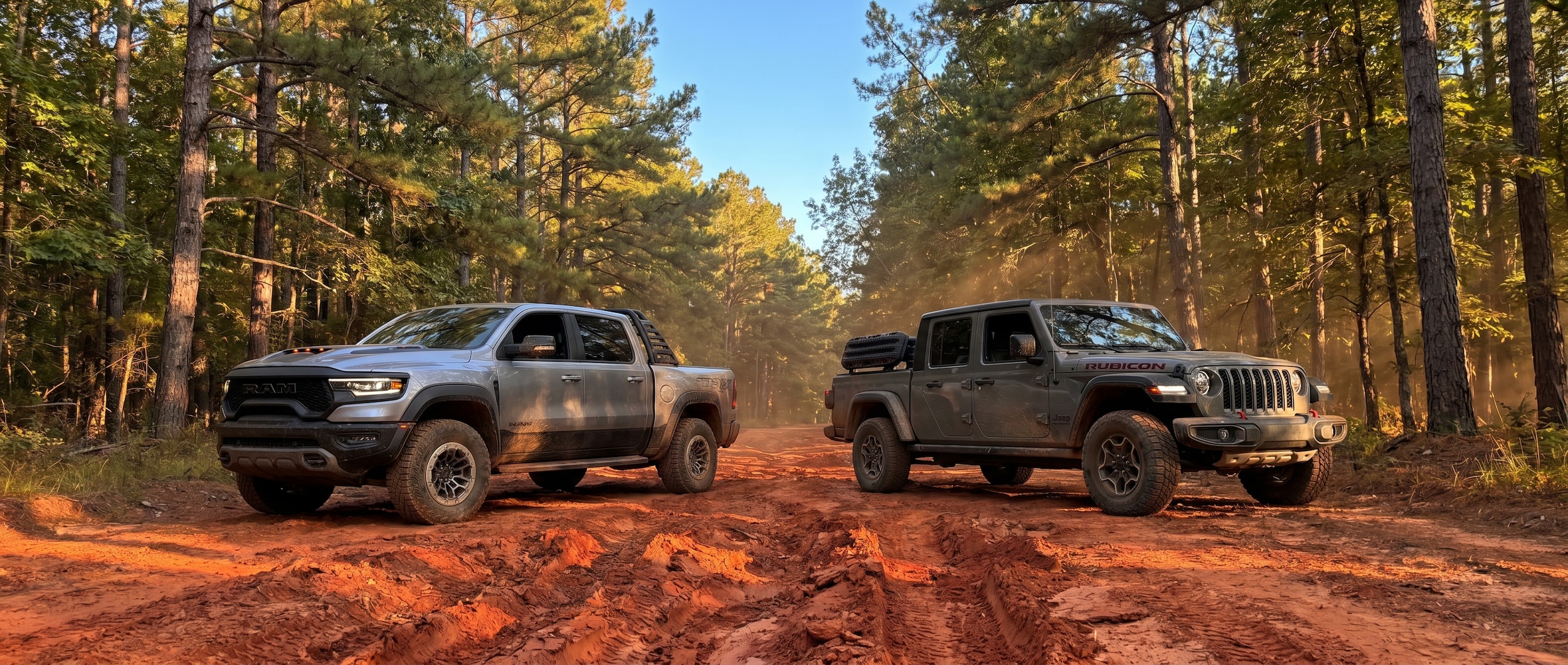
Two trucks that live in the same conversation keep landing in front of Birmingham, AL drivers who refuse to choose between getting work done and getting off the beaten path - the RAM® 1500 and the Jeep® Gladiator. Both carry gear, tow boats, and handle rough terrain. But they are built around very different ideas of what a truck should be, and picking the wrong one means living with a trade-off you didn't see coming. This guide breaks down exactly where each truck wins so you can make the right call for your life in and around Birmingham.
Why Birmingham Drivers Are Asking This Question in the First Place
The Birmingham, AL driver asking about this comparison isn't a casual weekend camper - they need a truck that earns its keep Monday through Friday and still has something left for Saturday on the trails at Oak Mountain State Park or a long haul up toward Smith Lake.
That dual demand is exactly what makes this comparison worth taking seriously. Birmingham sits in the Appalachian foothills, which means roads that roll, terrain that gets muddy, and summers that are hard on everything mechanical. Drivers here aren't just picking a truck based on looks. They're picking a tool that handles a specific combination of tasks that most other cities don't share.
The good news: both trucks are genuinely capable. The real question is which set of capabilities fits your actual daily schedule.
How These Two Trucks Differ at the Core
The RAM 1500 and the Jeep Gladiator™ are not the same truck wearing different badges - their core engineering priorities point in opposite directions.
| Feature | RAM 1500 | Jeep Gladiator |
|---|---|---|
| Bed Length | 5'7" (Crew Cab) to 8' | 5' (all configurations) |
| Max Towing Capacity | Up to 12,750 lbs | Up to 7,650 lbs |
| Max Payload | Up to 2,300 lbs | Up to 1,700 lbs |
| Off-Road Axle Options | Available (Rebel, TRX) | Standard Dana 44 axles |
| Open-Air Configuration | No | Yes - removable doors/top |
| Available 4WD Systems | Multiple | Available with lockers |
| GVWR | Up to 7,100 lbs | Up to 6,250 lbs |
The RAM 1500 is a full-size half-ton truck that prioritizes payload, towing, ride comfort, and interior space. The Gladiator is a midsize truck built on Wrangler DNA, prioritizing off-road articulation, trail capability, and the open-air experience that no RAM currently offers.
Neither truck is a compromise. They're just optimized for different problems.
Where the RAM 1500 Has a Clear Advantage
The RAM 1500 tows significantly more than the Gladiator, and for many Birmingham drivers that settles the conversation early.
If you're pulling a bass boat down to Lake Tuscaloosa on summer weekends, hauling a camper up to the Talladega National Forest, or moving equipment for a contracting job around Jefferson County, that towing gap matters. The RAM 1500 can handle loads that would strain the Gladiator's drivetrain.
The 1500 also wins on everyday livability:
- Bed space - The 5'7" or 6'4" bed options give you meaningful room for lumber, mulch, or gear that the Gladiator's 5-foot bed simply can't match
- Ride quality - The RAM 1500 uses a coil-spring rear suspension that absorbs highway miles better than most trucks in its class
- Crew cab interior - Rear passenger space is genuinely comfortable for adults, not an afterthought
- Long-haul capability - Multi-hour drives on I-20 or I-65 are more relaxed in the 1500's quieter cabin
Did you know? The RAM 1500 was the first half-ton pickup to use a coil-spring rear suspension as standard, a design that significantly reduces road noise and improves ride quality compared to traditional leaf-spring setups.
For Birmingham drivers who use their truck as a daily commuter through heavy traffic around the Colonnade area or Hoover while also needing serious capability on weekends, the 1500's combination of refinement and raw utility is hard to argue against.
Where the Gladiator Has a Clear Advantage
The Jeep Gladiator does things the RAM 1500 simply cannot do, and if those things matter to you, no amount of 1500 towing capacity changes that.
The Gladiator's off-road credentials come directly from the Wrangler's chassis. That means:
- Solid front and rear Dana 44 axles for serious trail work
- Available electronic front and rear locker differentials for technical terrain
- 35-inch tires available from the factory on Rubicon trims
- Removable doors and convertible top for an open-air experience no other pickup offers
- Better approach, departure, and breakover angles than the RAM 1500 across trim levels
If your Saturday regularly takes you to Cheaha State Park trails, the Talladega National Forest OHV areas, or routes that require genuine low-range crawling, the Gladiator's hardware is dialed in for that environment in ways the RAM 1500 isn't.
The open-air configuration is also genuinely different. There's no equivalent in the truck market - removing the doors and top for a trail run through Alabama's hill country on a clear fall morning is an experience the RAM 1500 cannot replicate.
Pro tip: If you run the Gladiator on technical trails, check your skid plates and undercarriage after each outing. Alabama's rocky red-clay terrain can deposit debris and cause wear that isn't always visible without getting underneath the truck.
Matching the Truck to Your Actual Birmingham Life
Here's where this decision gets personal. The right truck isn't the one with the better spec sheet - it's the one that fits the specific way you use Birmingham and the surrounding area.
Choose the RAM 1500 if your priorities look like this:
- You tow a boat, camper, or trailer regularly
- You haul material for work or home projects
- You need a comfortable daily driver for long commutes or frequent highway trips
- Your off-road use stays on maintained gravel roads or mild dirt trails
- You need rear seat space for a family or regular passengers
Choose the Gladiator if your priorities look like this:
- You trail-run seriously - rock crawling, mudding, technical OHV terrain
- The open-air experience is a meaningful part of why you want a truck
- Your towing needs stay under 7,500 lbs
- You want Wrangler-level off-road hardware in a truck format
- Weekend adventures matter as much as weekday utility
One honest note: if you're primarily a commuter who does light off-roading a few times a year and occasionally tows, the RAM 1500 will cover more of your actual life more comfortably. The Gladiator earns its cost when trail driving is a genuine priority, not an occasional aspiration.
How Alabama Terrain and Weather Affect This Decision
Birmingham's climate and geography create conditions that test both trucks differently throughout the year.
Alabama summers bring heat and humidity that are hard on cooling systems, tires, and interiors. The Gladiator's removable top means direct sun exposure in a way the RAM 1500's closed cab never experiences - not a dealbreaker, but worth considering for daily use in July heat. The Gladiator's soft-top and hardtop options each handle heat differently, and Alabama summer temperatures make this a real factor, not a theoretical one.
Winter in Birmingham brings occasional ice and snow that can appear quickly, especially on elevated roads around the Vulcan Trail area or heading north toward Gardendale. Both trucks offer capable 4WD systems for these conditions. The RAM 1500's stability control and available automatic 4WD make it genuinely manageable without driver intervention. The Gladiator's part-time 4WD system is capable but requires more active management in mixed surface conditions.
Birmingham's spring and fall are genuinely ideal seasons for either truck. The moderate temperatures, open trails in Oak Mountain State Park, and manageable trail conditions at Talladega make both trucks shine. This is when the Gladiator's open-air capability matters most and when the RAM 1500's ride comfort makes longer drives south toward Tuscaloosa or east toward Anniston genuinely pleasant.
What Ownership Actually Costs to Consider
Both trucks represent a serious investment, and the cost conversation goes beyond the sticker price.
The Gladiator's Wrangler-based hardware is well-supported by an enormous aftermarket - arguably the largest of any vehicle in the American market. Lift kits, armor, lighting, and trail accessories are plentiful and competitively priced. That said, the Gladiator's midsize platform means some fleet and commercial parts cost more than equivalent RAM 1500 components.
The RAM 1500 benefits from being one of the most popular vehicles in the United States. Parts availability is high, service intervals are well-documented, and the range of certified technicians familiar with its systems is broad. If you explore our new inventory, you'll find both trucks available in multiple trim configurations suited to different budgets and build priorities.
Did you know? The Jeep Gladiator is the first open-air pickup truck to market in the United States since the Jeep Scrambler was discontinued in 1987 - making it genuinely unique in the current truck landscape.
Common Questions About the RAM 1500 vs. Gladiator in Birmingham, AL
Which truck is better for towing a boat to Lake Tuscaloosa or Smith Lake?
The RAM 1500 is the stronger choice for regular boat towing in the Birmingham, AL area. With a maximum tow rating of up to 12,750 lbs, it handles most bass boats, pontoons, and ski boats without working near its limits. The Gladiator tops out at 7,650 lbs, which covers smaller boats but will feel the strain with larger vessels or heavier camper trailers.
Is the Jeep Gladiator capable enough for serious trail driving near Birmingham?
The Gladiator is one of the most capable trail trucks available without factory modifications. Its Dana 44 axles, available locking differentials, and high ground clearance handle Alabama's rocky, red-clay terrain well. For OHV areas in the Talladega National Forest or technical trails at Oak Mountain State Park, the Gladiator's hardware is purpose-built for exactly that environment.
How does the RAM 1500 handle Birmingham's occasional winter weather?
The RAM 1500 handles light snow and ice well, particularly with its available automatic four-wheel drive that can engage without driver input. Birmingham, AL sees infrequent but serious winter weather events, and the 1500's stability management system helps maintain control on elevated roads and bridges that ice first. All-terrain tires improve performance further.
Does the Gladiator work as a daily driver in Birmingham traffic?
The Gladiator works as a daily driver but requires adjustment from drivers used to full-size trucks or SUVs. Its shorter wheelbase makes parking easier in crowded lots near the Summit or Riverchase Galleria, but highway road noise is higher than the RAM 1500, and the ride is firmer. Drivers who daily-drive the Gladiator generally find it manageable but not as refined as the RAM 1500 for long commutes.
Which truck holds its value better in the Alabama market?
Both trucks have historically held strong resale value. The Gladiator benefits from its uniqueness - as the only open-air truck on the market, demand remains consistent. The RAM 1500 benefits from volume and broad appeal. Exact resale performance varies by trim, mileage, and condition, so speaking with the team at Hallmark Chrysler Dodge Jeep Ram about specific trim selections is a practical starting point.
Can I add serious off-road upgrades to a RAM 1500 for Alabama trail use?
The RAM 1500 Rebel and TRX trims come with meaningful off-road hardware from the factory, including Bilstein shocks, skid plates, and all-terrain tires. Aftermarket support for the RAM 1500 is substantial. That said, the Gladiator's Wrangler-based chassis is specifically engineered for extreme terrain articulation in ways a modified 1500 typically won't match. For moderate trails around Birmingham, a well-equipped 1500 is sufficient. For serious rock crawling, the Gladiator's engineering holds the edge.
Categories:
Social