





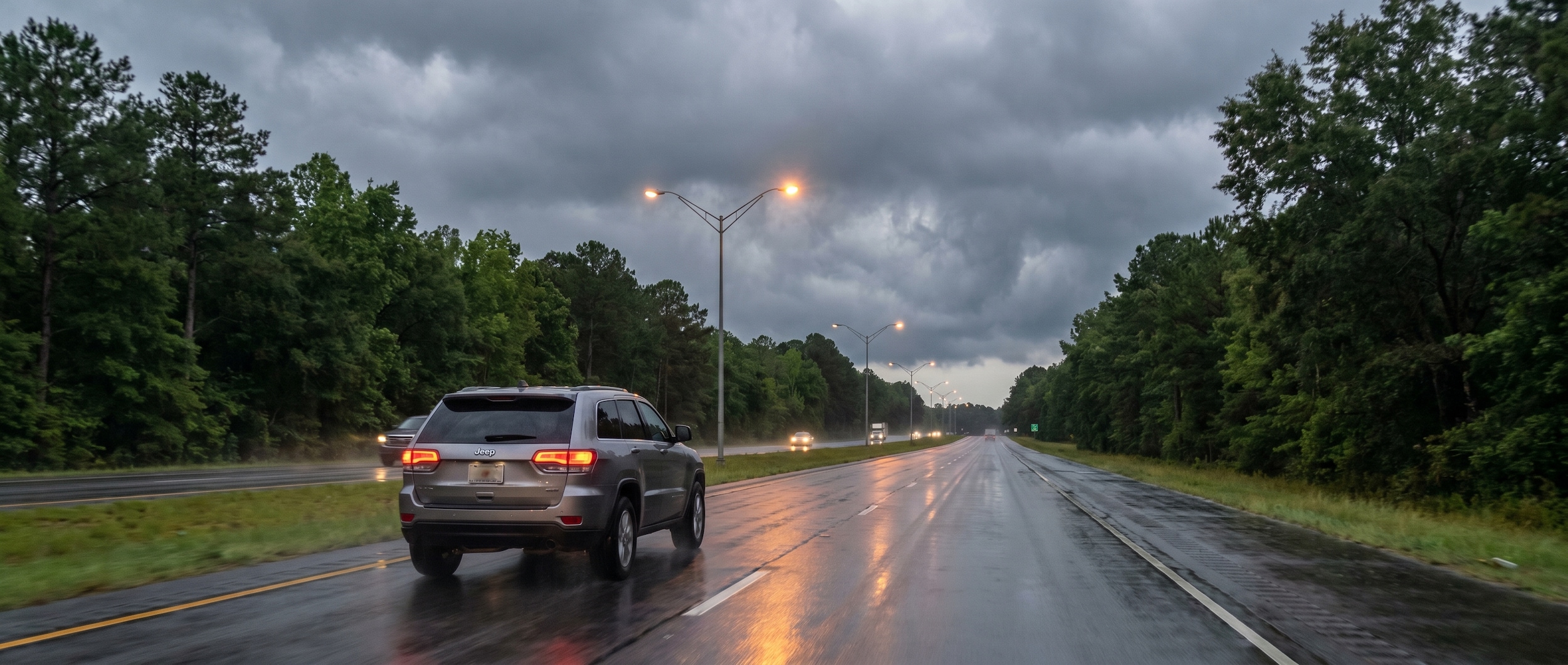
Alabama averages more than 55 thunderstorm days per year - one of the highest totals in the entire country - and Birmingham, AL drivers feel that reality from late spring straight through early fall. If you're driving a Jeep® Grand Cherokee® through a sudden downpour on I-65 or navigating standing water near the Cahaba River after a fast-moving storm cell rolls through, the features your SUV carries matter far more than most people realize until they need them. This guide breaks down the specific Grand Cherokee capabilities that are genuinely useful during Alabama's storm season, so you know exactly what to look for before the next line of storms shows up on your radar app.
Why Alabama's Thunderstorm Season Tests Your SUV Harder Than You'd Expect
Alabama's storm season is not a gentle, predictable affair. Severe thunderstorms here routinely bring flash flooding, reduced visibility that drops to near zero within seconds, and road surfaces that go from dry to treacherously slick before you can safely pull over. The combination of the state's clay-heavy soils, the number of low-water crossings throughout the greater Birmingham area, and the sheer intensity of Gulf-moisture-fueled storm systems creates driving conditions that genuinely stress-test every system in your vehicle.
The Grand Cherokee's reputation for all-terrain capability tends to get most of the attention in outdoor adventure conversations, but those same systems - traction management, ground clearance, suspension calibration - serve a completely different and equally important purpose when a thunderstorm rolls over Oak Mountain State Park and dumps two inches of rain in 45 minutes. Understanding what each feature actually does in wet conditions helps you drive with confidence rather than just hope.
Did you know? Flash flooding is the leading weather-related cause of vehicle fatalities in the United States, according to NOAA data. The majority of flood-related vehicle incidents occur when drivers attempt to cross water of unknown depth on roadways.
Quadra-Trac and Quadra-Drive: Traction When the Roads Get Slick
The Grand Cherokee's available all-wheel-drive systems are among the most practical features you can have when Birmingham's afternoon storms turn surface streets into rivers. Quadra-Trac II and the more capable Quadra-Drive II systems continuously monitor wheel slip and redistribute torque before you even sense a loss of traction - not after you've already started to slide.
Here's what makes this particularly relevant for Alabama driving conditions:
- Quadra-Trac I operates as a full-time AWD system with no driver input required - it works automatically in the background
- Quadra-Trac II adds a two-speed transfer case and a 50/50 front-to-rear torque split when needed
- Quadra-Drive II pairs the transfer case with rear electronic limited-slip differential for maximum torque control on slippery surfaces
- All systems engage without driver intervention, which matters when conditions change suddenly
That last point is worth emphasizing for anyone who commutes through areas like Hoover or Vestavia Hills, where hilly terrain and curved roads become genuinely unpredictable in a heavy downpour. The system does not require you to think about it - which is exactly what you want when visibility is poor and your full attention needs to be on the road ahead.
Rain-Sensing Wipers and Forward Lighting: Visibility That Keeps Up With the Storm
A feature that sounds almost too simple to discuss - automatic rain-sensing wipers - turns out to be one of the most practically useful features during an Alabama thunderstorm. On available trims, the Grand Cherokee uses optical sensors to detect precipitation on the windshield and automatically adjust wiper speed as rain intensity changes.
During a fast-moving storm cell near Vulcan Park or on the I-459 interchange, rain intensity can shift from light drizzle to wall-of-water conditions in under a minute. Manual wiper adjustment during that transition pulls your attention away from the road at exactly the wrong moment.
The Grand Cherokee pairs this with available adaptive LED headlights that automatically adjust beam direction as you steer through curves. On Birmingham's hilly, winding secondary roads, fixed headlights aim straight ahead while the road curves away from you in the rain. Adaptive lights follow the curve, illuminating the actual path you're traveling.
Storm visibility features available on Grand Cherokee trims:
| Feature | What It Does in Wet Conditions |
|---|---|
| Rain-sensing wipers | Automatically adjusts speed to match precipitation intensity |
| Adaptive LED headlamps | Steers light in the direction of travel on curves |
| Rear fog lights | Increases rear visibility for following drivers in heavy rain |
| Auto high-beam control | Switches between high and low beam without driver input |
| Heated mirrors | Clears moisture and prevents fogging of side mirror glass |
Ground Clearance and Water Fording: Built for Low-Water Crossings
The standard Grand Cherokee offers 8.6 inches of ground clearance, and available air suspension trims can raise that figure when needed. That matters in Alabama because low-water crossings - the kind found throughout Jefferson and Shelby counties on rural and semi-rural roads - can accumulate significant water depth even from a storm that doesn't feel particularly severe.
The Grand Cherokee is rated to ford up to 24 inches of water in properly equipped configurations. That specification comes directly from Jeep's engineering data, and it reflects the vehicle's sealed electrical connections, engine air intake positioning, and transfer case design.
Pro tip: Even with a capable SUV, never attempt to drive through moving water of unknown depth. The "Turn Around, Don't Drown" principle from the National Weather Service applies regardless of your vehicle's capability. Standing water depth can be deceiving, and moving water exerts significant force even at shallow depths.
The practical relevance for Birmingham area drivers: if you're returning from a weekend at Lake Purdy or coming back into the city after a storm has passed through, flooded sections of secondary roads are a genuine possibility. The Grand Cherokee's fording capability gives you meaningful options that a lower-riding sedan or crossover simply doesn't have.
Active Safety Systems That Work Harder in the Rain
Modern Grand Cherokee trims stack multiple active safety technologies that become measurably more valuable in wet weather. These aren't features that simply run in the background quietly - they actively intervene when sensors detect conditions your reaction time can't match.
Wet-weather active safety features on available Grand Cherokee trims:
- Blind-Spot Monitoring - Particularly useful in heavy rain when mirror visibility is compromised by water spray from adjacent vehicles on the highway
- Rear Cross-Traffic Alert - Helps when backing out of parking with reduced visibility from rain-fogged windows
- Automatic Emergency Braking - Detects obstacles and applies brakes faster than human reaction time allows, critical on wet roads where stopping distances increase significantly
- Lane Departure Warning with Lane Keep Assist - Lane markings become harder to see in heavy rain; this system helps compensate
- Adaptive Cruise Control with Stop - Maintains safe following distance automatically, accounting for sudden braking by vehicles ahead in poor visibility
Wet roads increase stopping distances substantially. At 60 mph on a dry road, the average stopping distance for an SUV is approximately 150-175 feet. On wet pavement, that distance can increase by 30-50%, depending on tire condition and road surface. Having a vehicle that begins braking before you fully process the need to brake is a meaningful safety advantage during storm season.
How Birmingham, AL Weather Patterns Should Influence Your Trim Choice
Not every Grand Cherokee trim carries all of these features, and choosing the right configuration for Alabama storm season is worth thinking through before you buy. Here's a practical way to think about it by driving pattern:
| Driving Pattern | Key Features to Prioritize | Suggested Grand Cherokee Trim Tier |
|---|---|---|
| Primarily city/highway commuting in Birmingham, AL | Rain-sensing wipers, AEB, blind-spot monitoring | Laredo E or Altitude |
| Mix of city and rural roads with occasional flooded areas | Add AWD system, higher ground clearance | Limited or Overland |
| Frequent rural travel, off-highway access, severe weather exposure | Quadra-Drive II, air suspension, full safety suite | Summit or 4xe configurations |
| Family hauler with school-run routes and suburban driving | Full safety suite, rear cross-traffic, larger display | Limited or Overland |
A note worth making here: the Grand Cherokee L, which offers three-row seating, shares most of these wet-weather capabilities with the standard model. Families coming in from communities like Trussville or Alabaster who need the extra row don't have to sacrifice storm-season capability to get the space.
Browse our new inventory to see which Grand Cherokee trim configurations are currently available and how they're equipped.
Common Questions About Jeep Grand Cherokee Features for Thunderstorm Season in Birmingham, AL
Is the Jeep Grand Cherokee good in heavy rain and flooding in Birmingham, AL?
The Jeep Grand Cherokee is well-regarded for wet weather capability among midsize SUVs. Available AWD systems, up to 24 inches of water fording depth on properly equipped trims, and strong ground clearance make it a practical choice for Birmingham, AL drivers who regularly encounter flash flooding, standing water on secondary roads, and sudden severe weather during Alabama's extended storm season.
Which Grand Cherokee trim has the most useful features for Alabama thunderstorm driving?
For Alabama thunderstorm season, the Grand Cherokee Limited and Overland trims offer the strongest balance of wet-weather safety technology and all-weather capability. These trims typically include rain-sensing wipers, available Quadra-Drive II all-wheel drive, the full active safety suite, and adaptive lighting. Drivers who regularly travel rural Jefferson County roads or Shelby County low-water crossings may want to evaluate the Overland or Summit for additional ground clearance capability.
Does the Grand Cherokee's AWD system turn on automatically in the rain?
Yes. The available Quadra-Trac II and Quadra-Drive II systems on the Grand Cherokee operate automatically without requiring driver input. The system continuously monitors wheel slip and redistributes torque in real time as road conditions change. You do not need to engage a mode or switch before driving into wet weather - the system responds as conditions develop.
How does rain affect stopping distances for SUVs in Birmingham, AL traffic?
Wet pavement can increase stopping distances by 30-50% compared to dry road surfaces, depending on speed, tire tread depth, and road surface texture. For Birmingham drivers on I-20, I-65, or Highway 280 during storm season, this means leaving significantly more following distance than feels instinctively necessary. The Grand Cherokee's available Automatic Emergency Braking assists by detecting and responding to obstacles faster than human reaction time allows in sudden stops.
Are Jeep Grand Cherokee tires adequate for Alabama wet roads, or should I upgrade?
Factory tires on most Grand Cherokee trims are all-season rated and perform adequately in typical Alabama rainfall. However, tire tread depth matters significantly in wet conditions. Tires worn below 4/32" of tread depth show measurably reduced hydroplaning resistance. If your Grand Cherokee is approaching 40,000-50,000 miles, it's worth having tread depth evaluated before storm season starts. Schedule service with your local dealer to have tires and all-weather systems inspected.
Can the Grand Cherokee handle flooded roads near Cahaba River during severe storms?
Water fording capability on properly equipped Grand Cherokee trims reaches up to 24 inches in controlled conditions. However, the relevant caution applies regardless of vehicle capability: never drive through moving or flowing water, and never enter water of unknown depth. The National Weather Service recommends treating any flooded roadway as impassable. The Grand Cherokee's capability is most useful for navigating flooded static sections of road where depth is known, or off-pavement situations in state parks and recreational areas during wet conditions.
Ready to Drive Through Alabama Storm Season With Confidence
Alabama thunderstorm season is not something you prepare for once - it runs through most of the year, and Birmingham drivers navigate its effects on a regular basis. The Jeep Grand Cherokee earns its reputation in these conditions through specific engineering choices: all-wheel-drive systems that respond before you react, ground clearance that gives you real options at flooded crossings, and a stack of active safety technology that compensates for what heavy rain takes away from visibility and road feel. The right trim, matched to how you actually drive through Jefferson and Shelby County, makes a genuine difference. The team at Hallmark Chrysler Dodge Jeep Ram is here to walk you through which Grand Cherokee configuration makes the most sense for where you live and how Alabama weather affects your daily routes.
Categories:
Social