





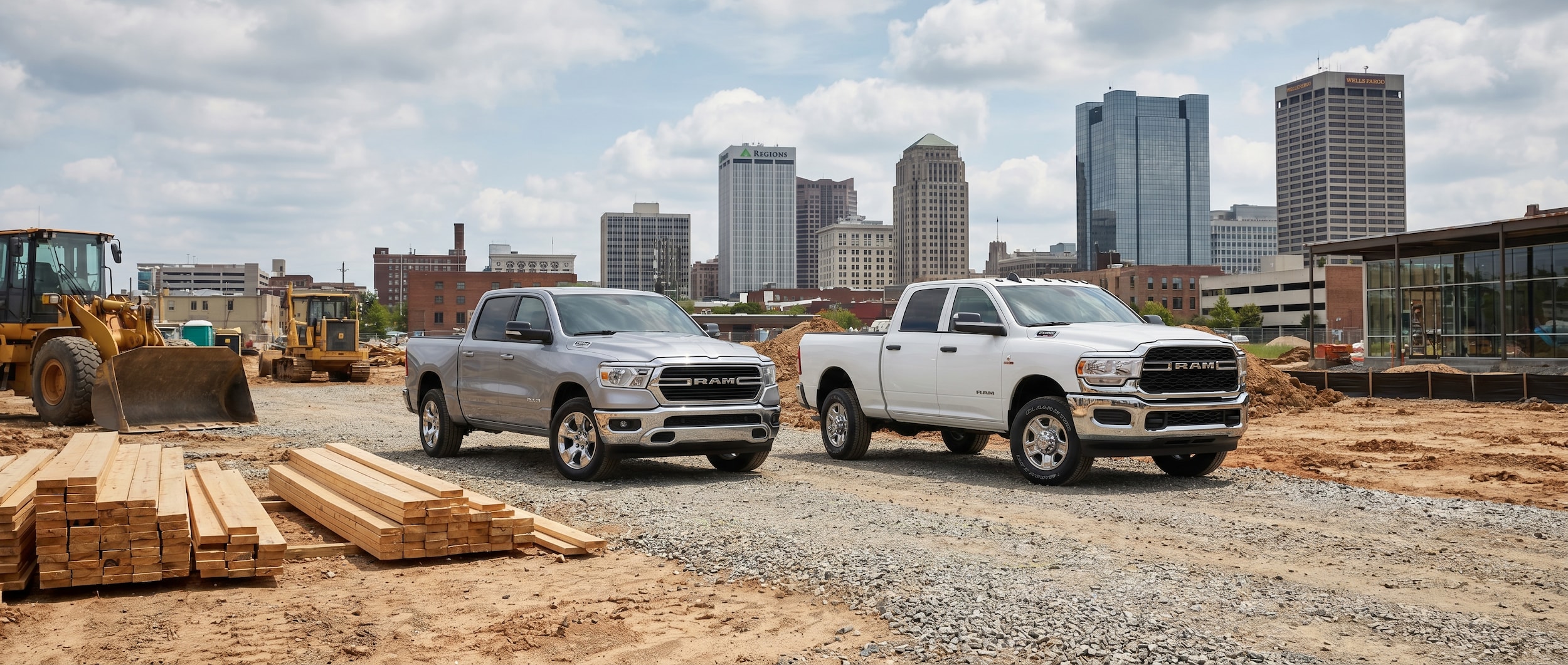
Business owners in Birmingham, AL face a critical decision when choosing between the RAM® 1500 and RAM 2500 - the 1500 delivers better fuel economy and easier daily driving, while the 2500 provides superior towing capacity up to 19,320 pounds and heavier payload ratings essential for construction and heavy equipment transport. Understanding your specific business needs, from daily job site trips around Red Mountain to hauling equipment on I-20, determines which truck maximizes your productivity and bottom line.
Understanding Your Business Truck Requirements
Your RAM truck choice directly impacts your business efficiency and operating costs - and McCalla business owners typically fall into three distinct categories based on their work demands.
Light-Duty Business Needs (RAM 1500 Territory):- Contractors handling residential projects
- Real estate professionals transporting signs and staging materials
- Landscapers with standard equipment loads
- Service businesses with tool and parts inventory
- Food service or catering operations
- Construction companies moving excavators or skid steers
- Plumbing and HVAC contractors with heavy service bodies
- Horse farm owners towing large trailers
- Equipment rental businesses
- Commercial towing operations
Pro tip: Calculate your maximum payload and towing needs during your busiest season, then add 20% capacity for growth and safety margin.
The dividing line typically falls around 10,000 pounds of regular towing or 2,000 pounds of consistent bed payload. If your work keeps you below these thresholds, the 1500 offers better maneuverability around tight Birmingham job sites while saving significantly on fuel costs during those daily runs between Bessemer and Hoover.
Comparing Towing and Payload Capacities
The numbers tell a compelling story when you examine what each RAM truck delivers for Birmingham-area businesses operating in challenging conditions.
| Specification | RAM 1500 | RAM 2500 | Business Impact |
|---|---|---|---|
| Max Towing | 12,750 lbs | 19,320 lbs | Equipment transport capability |
| Max Payload | 2,300 lbs | 4,010 lbs | Bed loading capacity |
| GVWR | 7,100 lbs | 10,000 lbs | Legal weight limits |
| Rear Axle Rating | 3.92 ratio | 4.10 ratio | Pulling power |
Your daily operations around Oak Mountain State Park construction sites or hauling materials up Highway 280's steep grades demand different capabilities. The 2500's additional capacity proves invaluable when towing concrete mixers, loaded equipment trailers, or multiple pieces of heavy machinery.
RAM 1500 Sweet Spot Applications:- Enclosed tool trailers under 8,000 pounds
- Single-axle dump trailers
- Landscape equipment on standard trailers
- Small boats for marine service businesses
- Light construction materials
- Gooseneck trailers with multiple machines
- Heavy fifth-wheel service bodies
- Tandem-axle equipment haulers
- Commercial-grade wood chippers
- Loaded car haulers
Remember that these capacities assume proper configuration - adding the right towing package, brake controller, and bed equipment makes the difference between struggling with loads and confident operation.
Real-World Performance and Daily Operations
Operating costs significantly impact your bottom line, especially when your trucks rack up miles between job sites across Jefferson and Shelby counties.
The RAM 1500 with its 3.6L V6 eTorque achieves up to 25 MPG highway, while the 2500's 6.4L HEMI® V8 typically delivers 17-19 MPG highway. For a McCalla contractor driving 30,000 annual miles, that difference amounts to approximately $1,500-$2,000 in yearly fuel costs at current Alabama prices.
Did you know? RAM's eTorque mild hybrid system in the 1500 provides up to 130 lb-ft of additional launch torque, improving both fuel economy and acceleration when merging onto I-459 with heavy loads.
Daily drivability varies dramatically between models. The 1500's coil spring rear suspension (or available air suspension) provides car-like comfort during empty runs to Oak Mountain Amphitheatre for event setup work. Meanwhile, the 2500's leaf spring setup, while harsher unloaded, maintains level stability when hauling maximum payloads through downtown Birmingham's potholed streets.
Maneuverability Comparison:- RAM 1500 turning radius: 23.9 feet
- RAM 2500 turning radius: 26.7 feet
- Impact: Easier navigation in residential neighborhoods and tight commercial lots
Parking garage clearances throughout Birmingham also favor the 1500, with its lower stance fitting comfortably in most structures around UAB Hospital and the BJCC complex.
Cost Analysis for Birmingham Business Owners
Initial purchase price represents just the beginning of your truck investment - total ownership costs over a typical 5-year business cycle reveal the complete picture.
| Cost Category | RAM 1500 (Annual) | RAM 2500 (Annual) |
|---|---|---|
| Insurance | $1,400-1,800 | $1,600-2,100 |
| Registration | $125-150 | $235-285 |
| Fuel (30k miles) | $3,600-4,200 | $5,200-6,000 |
| Maintenance | $800-1,200 | $1,000-1,500 |
| Tires | $300-400 | $400-600 |
Alabama's commercial vehicle regulations add another layer - vehicles over 10,000 pounds GVWR require commercial tags and potentially CDL licensing depending on configuration. The 2500 crosses this threshold, increasing both costs and regulatory requirements for Hoover-based businesses.
Pro tip: Many Birmingham business owners find success with mixed fleets - RAM 1500s for supervisors and daily runners, RAM 2500s for dedicated hauling crews.
Tax implications through Section 179 deductions often favor heavier trucks, with the 2500 potentially qualifying for larger first-year depreciation benefits. Consult your accountant about maximizing these advantages based on your specific business structure and equipment needs.
Browse our new inventory to compare current RAM 1500 and 2500 configurations that match your business requirements.
Making the Right Choice for Your McCalla Operation
Your business location and typical routes throughout the Birmingham metro significantly influence the optimal truck choice.
Choose RAM 1500 When:- Most work stays within Birmingham city limits
- Towing needs remain under 10,000 pounds
- Fuel economy impacts profitability
- Crew comfort during long days matters
- Residential access is frequent
- Regular equipment transport exceeds 12,000 pounds
- Payload often surpasses 2,000 pounds
- Stability under load trumps ride comfort
- Commercial job sites dominate your schedule
- Growth plans include heavier equipment
Consider how your business has evolved over the past three years and where you expect growth. That landscape company starting with push mowers might soon add commercial zero-turns and wood chippers, pushing beyond 1500 capabilities. Conversely, the general contractor focusing on residential remodels around Mountain Brook may never need 2500-level capacity.
Check out our pre-owned inventory if you're exploring certified options that balance capability with budget.
Common Questions About RAM 1500 vs 2500 for Birmingham Businesses
How do RAM 1500 and 2500 trucks handle Birmingham's summer heat when towing?
Both RAM trucks feature heavy-duty cooling systems, but the 2500 includes larger transmission and engine oil coolers standard, maintaining optimal temperatures when climbing Red Mountain with maximum loads during 95-degree summers. The 1500 requires the Max Tow Package for equivalent cooling capacity, essential for businesses regularly pulling trailers on I-65.
What's the real MPG difference between RAM 1500 and 2500 in Jefferson County driving?
Birmingham business owners typically see RAM 1500s achieving 18-20 MPG in mixed driving, while RAM 2500s average 14-16 MPG in similar conditions. Stop-and-go traffic on Highway 280 or frequent job site visits in Bessemer impact the heavier 2500 more significantly, widening the fuel economy gap during busy work weeks.
Do I need a CDL to drive a RAM 2500 for my Alabama business?
Alabama doesn't require a CDL for standard RAM 2500 pickups under 26,000 pounds GCWR (Gross Combined Weight Rating), but specific configurations with heavy trailers might push you over this threshold. Most McCalla contractors operate 2500s with standard driver's licenses, though commercial tags and DOT numbers may apply based on business use.
Which RAM truck works better for Birmingham area construction sites?
RAM 2500s excel at construction sites requiring heavy material delivery or equipment transport, while their ground clearance handles rough terrain around new developments near Oak Mountain. RAM 1500s prove ideal for supervisors and sales teams visiting multiple sites daily, offering easier parking at crowded job locations and better fuel economy for extensive Birmingham-area travel.
How do warranty and service intervals differ between RAM 1500 and 2500?
Both RAM models include 5-year/60,000-mile powertrain warranties, but service intervals vary based on usage severity. The 2500's heavier-duty components typically require transmission service every 60,000 miles under severe use, compared to 120,000 miles for normal 1500 operation, impacting maintenance scheduling for busy Birmingham businesses.
Can a RAM 1500 with Max Tow Package match a base RAM 2500?
While a properly equipped RAM 1500 with Max Tow approaches 13,000 pounds towing capacity, it cannot match the RAM 2500's payload capacity, brake size, or frame strength. Birmingham businesses occasionally maxing out towing might manage with a 1500, but those regularly approaching capacity limits need the 2500's built-in reserve strength and larger components.
Your Next Step Toward the Right RAM Truck
Selecting between the RAM 1500 and RAM 2500 ultimately depends on accurately assessing your Birmingham business needs today while planning for tomorrow's growth. The 1500 excels for businesses prioritizing fuel efficiency, daily comfort, and moderate hauling needs around town. The 2500 becomes essential when your success depends on moving heavy equipment reliably and safely throughout Central Alabama.
Consider scheduling test drives with both trucks loaded to simulate your typical work conditions - experience the difference climbing Shades Crest Road with a trailer or navigating downtown Birmingham job sites. The team at Hallmark Chrysler Dodge Jeep Ram understands the unique demands McCalla business owners face and can demonstrate how each truck performs under real-world conditions. Your business deserves equipment that enhances productivity rather than limiting growth potential.
Categories:
Social