




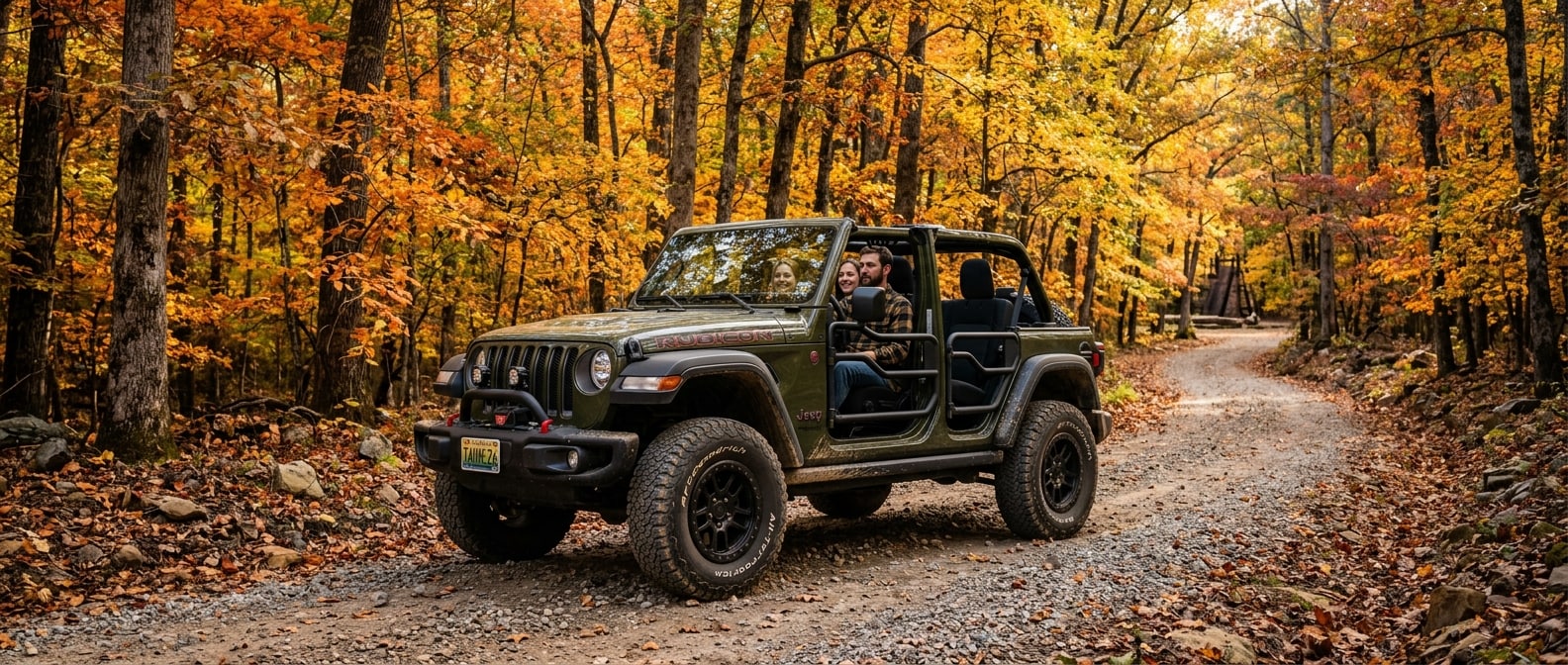
October hits differently when you're standing on a packed-gravel trail under a hardwood canopy that's gone full orange and gold. Tannehill Ironworks Historical State Park in McCalla sits about 12 miles south of Bessemer off I-59/I-20 and covers more than 1,500 acres across three Alabama counties. More than 30 miles of trails thread through pine and hardwood forest, along Roupes Creek, and up the ridge lines. Fall foliage is real here, and the Trade Days market runs the third weekend of every month through November.
The short version is that the 2026 Jeep Wrangler is built for exactly what Tannehill throws at a vehicle in October. Wet creek crossings. Root-laced climbs after a rain. Soft leaf-covered gravel where everything looks dry but isn't. And the kind of autumn afternoon where you want the doors off and the sky above you.
The Jeep Wrangler Rubicon's 10.8 inches of ground clearance and electronic front sway-bar disconnect are the specific mechanical reasons it handles Tannehill's creek crossings and rooted woodland climbs better than a standard crossover.
Why Does the Jeep Wrangler Fit Here?
The short answer is geometry, and the Wrangler suits Tannehill because its trails reward short overhangs, serious articulation, and real water fording, but that same capability costs you some road polish, so you trade refinement for the ability to go where the trail leads. Line up what the 2026 Wrangler Rubicon brings against what the park actually demands.
| Local Condition at Tannehill | Wrangler Feature That Handles It | Why It Matters Here |
|---|---|---|
| Roupes Creek and Mud Creek crossings on woodland trails | Up to 34 inches of water fording depth (Jeep-rated) | Standard crossovers ford around 12-18 inches; Tannehill creek crossings after fall rains can surprise you |
| Root-laced, uneven woodland trail surfaces | Electronic front sway-bar disconnect (Rubicon) | Lets the front wheels articulate independently to keep all four tires planted over uneven terrain |
| Steep wooded ridgeline climbs | Rock-Trac 4:1 low-range; up to 100:1 crawl ratio (Rubicon w/ available 4.88 axle) | Precise, slow control on ascents without spinning out |
| Soft leaf-covered gravel access roads | Tru-Lok front and rear electronic locking differentials | Equal torque to both wheels on each axle when grip disappears under wet leaves |
| Fallen-timber obstacles on trails like Ridge Trail and Iron Man | 10.8 inches of ground clearance (Rubicon, standard 33" tires) | Clears low obstacles that snag a crossover's front air dam |
| Hauling camping gear for 195-site campground stays | Up to 72.4 cubic feet of cargo space (4-door) with rear seats down | Room for a weekend's worth of gear plus firewood |
| Fall color canopy, the whole point of going in October | Removable doors and fold-down windshield | You drove to the park. The park should actually be around you. |
That table doubles as the trade-off list. The Wrangler's Trail Rated hardware earns its keep at Tannehill, and what it costs you is refinement. The 3.6-liter V6 four-door earns an EPA estimate of 17 city and 23 highway, which isn't embarrassing for a body-on-frame 4x4, but it's no crossover number. Wind noise above 60 mph is real. You choose this vehicle for capability and openness, not highway cruising comfort. Know that going in.
Solid Axles Make the Difference on Tannehill's Woodland Terrain
Solid axles are what set the Wrangler apart on terrain like this, because most SUVs in the segment run independent front suspension for a smoother road feel, and the Wrangler Rubicon instead commits to solid front and rear axles, specifically third-generation heavy-duty Dana 44 units front and rear, trading a hair of ride comfort for grip. On a trail like Tannehill's Iron Runner Loop or the Ridge Trail, one front wheel can be climbing a root while the other drops into a rut, and the solid axle keeps more tire in contact with the ground without giving anything up underneath. The engineering isn't glamorous, but it earns the trade on the trail.
The electronic front sway-bar disconnect compounds that. Press the button and the front stabilizer bar uncouples, letting each front wheel travel through its full range of motion independently. On a flat highway, you want the sway bar connected to keep the Wrangler composed. On a rooted trail climb, you want it disconnected. The Rubicon lets you do both, driver-controlled, without stopping, and you don't even have to get out. The capability is still rare here.
Tip for Tannehill visitors: Trail conditions here can shift fast after rain, and the park's website and trail apps like Trailforks post recent status reports. A large downed tree on the Iron Man trail and minor issues on Cannon Ball Loop both showed up in reports from late September 2026. Check conditions before you load up, since you don't want surprises mid-October when leaves can hide the trail surface.
Next step: The park's Trade Days runs the third weekend of every month through November. That's October 18-19 and November 15-16 this fall. If you want to have the Wrangler before those weekends, stop in at Hallmark Chrysler Dodge Jeep Ram on 5th Avenue North and we'll put you in the right trim for your plans.
The Open-Air Case: October Is the One Month the Doors-Off Experience Pays Off
October is the single best month for the doors-off experience at Tannehill, and the 2026 model leans right into it with a redesigned hinge system that drops the doors faster than earlier generations, even though you trade away roof and weather protection to enjoy it. Jeep retooled the hinges specifically to address the hassle Wrangler owners had raised, and you'll feel the difference the first time you pull a door.
On most trims the doors come off, and the windshield folds flat. October in central Alabama is the single window where the temperature cooperates, the bugs are mostly gone, and Tannehill's hardwood canopy peaks. Sixty degrees, golden light, the sound of Roupes Creek below the trail. You can't get that through a panoramic sunroof.
Browse our current Wrangler inventory to see which trims and color options we have in stock right now.
The honest limitation holds here too. Doors-off driving is loud and exposed. If you need a practical daily commuter five days a week and a trail vehicle on weekends, the Wrangler works. If you need one vehicle that does both quietly, look at the Jeep Grand Cherokee instead, a capable SUV with a far more refined highway ride. The Wrangler is for drivers who've already decided the trail matters more than the commute.
Why Fall at Tannehill Is Different from a Summer Run
Fall changes the calculus at Tannehill in ways summer never does, and where a summer run gives you humidity, heat, and full green canopy over good trails, autumn brings color, slicker ground, and bigger crowds that all point toward a more capable vehicle. Start with the foliage. The hardwood mix of oak, hickory, and pine along the Cannon Ball Loop and the Pig Iron and Cannon Ball Loop runs through genuine color change in October. Next comes the ground, where fall rains turn the creek crossings and the steeper switchbacks slick underfoot. Then there's Trade Days, the market on the third weekend of each month, which draws vendors and visitors and puts the park's gravel parking areas and access roads under real use. A vehicle that handles soft, leaf-wet gravel earns its keep in a way it never has to in a dry August.
The Wrangler's Tru-Lok locking differentials answer the second point directly. When grip drops on a wet, leaf-covered rise, the lockers send equal torque to both wheels on each axle, so you don't give up momentum through a slick section. The fit is that specific.
If your Tannehill plans include an overnight at the campground and a weekend of Trade Days, the park's 195 improved campsites make a strong basecamp, and the Wrangler hauls the gear for all of it, so reach out to Hallmark Chrysler Dodge Jeep Ram and we'll talk through your purchase timeline.
Categories:
Social