




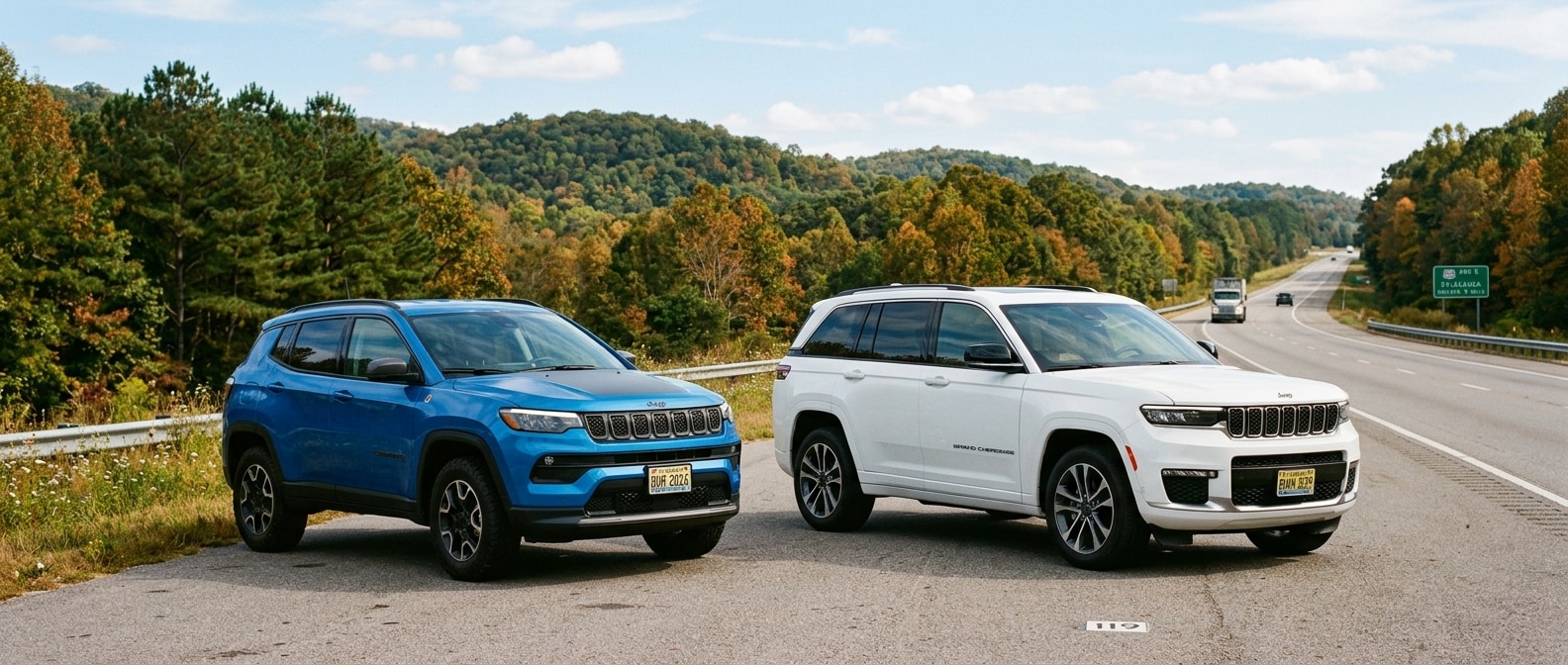
The short answer works like this. If you're running US-280 solo or as a pair and parking anywhere near Homewood, the 2026 Jeep Compass earns its keep every single day. If you're hauling real passengers, a weekend boat, or camping gear up to the Appalachian foothills, the 2026 Jeep Grand Cherokee does a job the Compass genuinely cannot.
The short version
- The 2026 Jeep Compass gets an EPA-estimated 26 mpg combined; the 2026 Jeep Grand Cherokee (Hurricane engine) rates 23 mpg combined. You'll feel that over a five-day commute on US-280.
- The Grand Cherokee tows up to 6,200 lbs; the Compass caps at 2,000 lbs. The gap matters the moment a jon boat or a loaded cargo trailer enters the picture.
- The Compass is 20 inches shorter than the Grand Cherokee. On narrow side streets in Mountain Brook or a tight parking deck, those 20 inches decide whether it's easy or stressful.
- Both come standard with AWD in 2026. Neither leaves you guessing on a wet Red Mountain climb.
- The deciding factor comes down to how often Saturday changes what your vehicle needs to be.
What's the Real Difference Between These Two Jeeps?
They share the Jeep badge and the same trail-capable DNA, but drive them back to back on US-280 and the gap shows up right away, because the Compass is a compact SUV built around a 173.4-inch body and a 200-horsepower, 2.0-liter turbocharged four-cylinder, while the Grand Cherokee runs longer and carries far more engine. The Grand Cherokee stretches to 193.5 inches and, for 2026, arrives with a brand-new 2.0-liter Hurricane 4 Turbo as the standard engine on most trims, pushing 324 horsepower and 332 lb-ft of torque. You get 124 more horsepower between you and the merge on the Elton B. Stephens Expressway.
| Spec | 2026 Jeep Compass | 2026 Jeep Grand Cherokee |
|---|---|---|
| Engine | 2.0L Turbo I4 | 3.6L V6 or 2.0L Hurricane Turbo I4 |
| Horsepower | 200 hp | 293 hp (V6) / 324 hp (Hurricane) |
| EPA Combined MPG | 26 mpg | 23 mpg (V6: 22 mpg) |
| Towing Capacity | 2,000 lbs | Up to 6,200 lbs |
| Cargo (seats up) | 27.2 cu ft | 37.7 cu ft |
| Cargo (seats down) | 59.8 cu ft | 70.8 cu ft |
| Length | 173.4 in | 193.5 in |
| Standard Drivetrain | AWD (all trims) | RWD standard / 4x4 available |
| Ground Clearance | Up to 8.7 in (Trailhawk) | 8.4 in standard / 10.9 in (Quadra-Lift) |
Both carry Jeep's Selec-Terrain system, and you'll notice the split on the trail hardware. The Compass Trailhawk adds Active Drive Low with a 20:1 crawl ratio. Configure the Grand Cherokee with Quadra-Drive II and Quadra-Lift air suspension and clearance climbs to 10.9 inches for serious off-road use.
The single deciding factor is the Grand Cherokee's new 2026 Hurricane engine, which produces 324 horsepower and tows 6,200 lbs. The Compass produces 200 horsepower and tows 2,000 lbs. If Saturday ever includes a trailer, the choice is already made.
Does the MPG Gap Matter for a US-280 Commute?
It does matter, though not enough to sink the Grand Cherokee for everyone, because the EPA rates the 2026 Jeep Compass at 23 city / 31 highway mpg and the Grand Cherokee with the Hurricane engine at 21 city / 27 highway, and that 4-mpg city difference lands hardest on the stop-and-go between Homewood and downtown. Over a typical five-day week on that commute, the Compass is measurably cheaper to fuel. For a solo commuter, that's the honest downside of the Grand Cherokee, and we're not going to pretend otherwise. Homewood sits just south of downtown Birmingham on US-280.
So does the highway change the math? Yes, it does. The Grand Cherokee closes that gap faster than the raw size difference suggests once you get onto the open stretches past Cahaba Heights, where the Hurricane engine settles into a cruise. But in bumper-to-bumper conditions between the I-459 interchange and the city, the Compass wins on fuel. It also wins on parking. At 173.4 inches, it slips into gaps a 193.5-inch Grand Cherokee simply won't.
Explore financing options if the trim-level question is what's holding up the decision (we work with both vehicles across the full trim range).
Size, Cargo, and the Back Seat Reality
Families cross-shopping this pair hit something the spec sheet glosses over, because the Compass holds 27.2 cubic feet of cargo with the rear seats up and the Grand Cherokee holds 37.7 in the same configuration, and that 10.5-cubic-foot gap is roughly the line between packing a weekend comfortably and playing Tetris with the bags at the liftgate. With seats folded, the gap widens to 59.8 cubic feet in the Compass against 70.8 in the Grand Cherokee. The Grand Cherokee also gives rear passengers 38.6 inches of legroom (enough that an adult can sit back there without audible complaints on a two-hour run toward Lake Martin or Cheaha State Park).
The Compass is genuinely comfortable for two adults and two kids. It isn't comfortable for four adults on a longer drive. No criticism there. A compact SUV is doing exactly what it's designed to do. But if the back seat carries grown people on the regular, the Grand Cherokee is the right answer.
On the Trail: The Compass Trailhawk's Active Drive Low system delivers a 20:1 crawl ratio, which handles the sort of gravel Forest Service roads around the Talladega National Forest that most compact SUVs won't attempt. The Grand Cherokee's available Quadra-Lift air suspension raises the ride height to 10.9 inches of clearance for more demanding terrain. Different tools for different trails.
So Which Should You Pick for US-280?
The split comes down to your week, and it's cleaner than most comparisons, so we'll give you a straight read on each side rather than push you toward the bigger badge, because the right pick depends entirely on what Saturday asks of the vehicle.
Pick the Jeep Compass if: You're commuting US-280 most days and parking in a deck or a tight lot. You're a couple or a small family with kids young enough that the back seat works fine. You want AWD standard on every trim (a 2026 Compass feature across the board) without paying for capability you won't touch on weekends. You'll feel the EPA's 23-city / 31-highway rating over a year of Birmingham commuting.
Pick the Jeep Grand Cherokee if: The back seat carries real passengers on a regular basis. You pull a boat, a camper, or a trailer (anything over 2,000 lbs puts the job outside what the Compass is rated for). You want the new Hurricane 4 Turbo's 324 horsepower, which takes the grade up Red Mountain or a quick merge onto I-459 without the engine working hard. You need the Grand Cherokee's 70.8 cubic feet of maximum cargo for gear runs the Compass can't match.
We'd flag one caution before you decide. Don't buy the Grand Cherokee because it feels more capable if your Saturday never involves a trailer or a trail. You'll pay for towing capacity and horsepower you don't use, and you'll feel the fuel cost on every commute. And don't talk yourself into the Compass if your family actually needs the room. The Compass is a terrific vehicle for the right buyer, not a stand-in for a midsize when a midsize is truly what the situation calls for.
See current Compass inventory and compare it against what we've got in the Grand Cherokee lineup (both are on the lot, and we're happy to put you in each the same afternoon).
Value Your Trade-In Before You Decide
Both vehicles earn real respect from our team. The Compass is lighter, more efficient, and legitimately fun to drive on a winding US-280 back road. The Grand Cherokee is a midsize SUV that carries five adults in genuine comfort, hauls 6,200 pounds when properly equipped, and still fits in a standard garage.
One of them fits your actual week. The other fits the version of your week you picture in your head. We'll help you sort out which is which.
Frequently Asked Questions
Does the 2026 Jeep Grand Cherokee get significantly worse fuel economy than the Compass?
Yes, though not as dramatically as the size difference might suggest. The EPA rates the 2026 Jeep Compass at 23 city / 31 highway mpg. The 2026 Jeep Grand Cherokee with the new Hurricane 4 Turbo engine comes in at 21 city / 27 highway mpg, and the base V6 rates 19 city / 26 highway mpg. For a daily US-280 commuter doing plenty of stop-and-go, the Compass is the more fuel-efficient pick. The Grand Cherokee closes the highway gap more than the city numbers let on, but over a full week of Birmingham driving, the Compass costs less to fuel.
Can the 2026 Jeep Compass tow a boat or small camper?
The 2026 Jeep Compass is rated to tow up to 2,000 pounds when properly equipped. That covers a small jon boat, a lightweight utility trailer, or a very compact pop-up camper. Once your trailer or boat clears 2,000 pounds (which takes in most fishing boats and a large share of travel trailers), the Compass isn't the right vehicle for the job. The 2026 Jeep Grand Cherokee is rated to tow up to 6,200 pounds with the right equipment, which covers most boats, small travel trailers, and the loaded cargo trailers Birmingham-area buyers actually haul.
Categories:
Social