



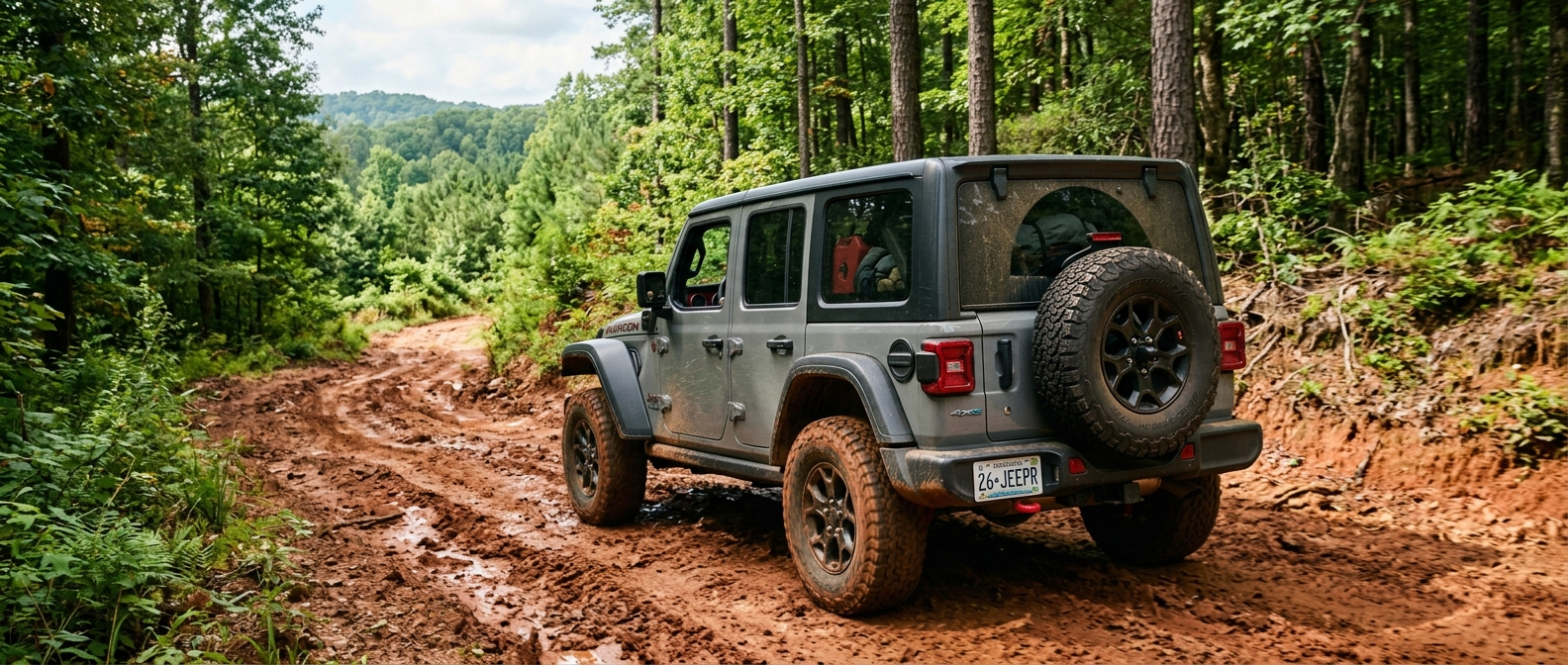
The 2026 Jeep Wrangler puts up 12.9 inches of ground clearance (with the Xtreme 35 package on a Rubicon), 34 inches of water-fording capability, and a 100:1 crawl ratio. Those numbers earn their keep on the red-clay two-tracks and creek-bottom approaches east of Leeds toward the Shoal Creek District of Talladega National Forest. What they won't tell you is how the wheelbase feels on a tight switchback, or whether the four-door Unlimited's 116.5-inch footprint clears that washed-out approach before it bottoms out. So drive one now, in September, before Alabama archery season opens in October and before the first rain turns every clay road into a skating rink, or close to it.
Before You Hit the Trail: The Basics That Matter on Alabama Access Roads
| Do | Don't |
|---|---|
| Engage 4-Low before a steep, wet grade (the Rubicon's Rock-Trac delivers a 4:1 low gear ratio for controlled descent) | Lock into 4-Low on dry pavement because transfer case damage follows |
| Let the Wrangler's 9.7-inch minimum ground clearance (standard Sport) or 12.9-inch Rubicon clearance do the work on root-strewn forest floor | Assume the Sport's clearance matches the Rubicon's without checking your trim first |
| Check your water depth before fording. Jeep rates the Wrangler at up to 34 inches of water-fording capability, but crossing without knowing what's underneath voids that rating fast | Cross a creek blind; creek bottoms in the Shoal Creek District shift after every significant rain |
| Use the available Trails Offroad integration (built into the Uconnect 12.3-inch screen, accessible via Apple CarPlay) to pull a trail map before you leave the highway | Trust memory on a fire road you haven't run in two seasons |
| Engage the Electronic Sway Bar Disconnect on Rubicon models for maximum axle articulation on rock and root crossings | Leave sway bar disconnected for the I-20 drive back into Leeds (reconnect before you return to pavement) |
The One Technique That Actually Changes How a Wrangler Performs on Hill-Country Clay
Crawl ratio is the spec that quietly decides how a Wrangler behaves on Alabama foothill clay, and the 2026 Wrangler Rubicon's Rock-Trac 4x4 system produces a 100:1 crawl ratio when you pair the manual transmission with the available 4.88:1 axle ratio. In practical terms, that's enough torque multiplication to inch forward on a slick, leaf-covered grade without spinning a tire and cutting a rut that gets worse on the way out. The ratio does the holding for you.
Your day-to-day approach changes in one spot. Feather the throttle, not the brake. On an ascending clay surface, hunters who've driven trucks lean on the brakes when traction breaks. In a Wrangler on a technical pitch, you dial the throttle down and let the crawl ratio do the holding work. Browse our Wrangler inventory to see which transmission and trim combinations are in stock right now, because that ratio changes dramatically between the Sport (Command-Trac, 2.72:1 low) and the Rubicon.
Let's be straight about where the Wrangler gives ground, because the forums are full of hunters who found out the hard way. Highway miles from Leeds to the Talladega corridor on I-20 are real. The Wrangler's body-on-frame design and solid axles, which make it exceptional on clay and creek crossings, produce noticeable road noise and a firmer ride at highway speed compared to a crossover. If your season means an hour each way on the interstate before you touch a single dirt road, that's a trade-off worth knowing before you buy. Our pre-owned inventory includes Wranglers at various trim levels if you want to test both ends of that trade-off.
One Reason September Is the Right Month to Schedule This Drive
The Wrangler's 47.4-degree approach angle and 40.4-degree departure angle (four-door Rubicon with the Xtreme 35 package, per Jeep) only make sense once you've felt how the nose drops into a descent. Roll up to a hunt access point in November, drop a deer, then discover your trim can't climb back out, and you've lost the whole day. A drive on a Tuesday costs nothing.
The Jeep Gladiator deserves a mention here, since it adds a pickup bed for hauling gear, and plenty of hunters in this area cross-shop the two head-to-head. The Gladiator's longer wheelbase trims its off-road geometry relative to the Wrangler's short wheelbase, and the two-door Wrangler's 100.0-inch wheelbase actually produces a sharper breakover angle than the four-door on truly technical terrain. Come in. Tell us where you're hunting, and we'll put you in both if that comparison matters to you.