





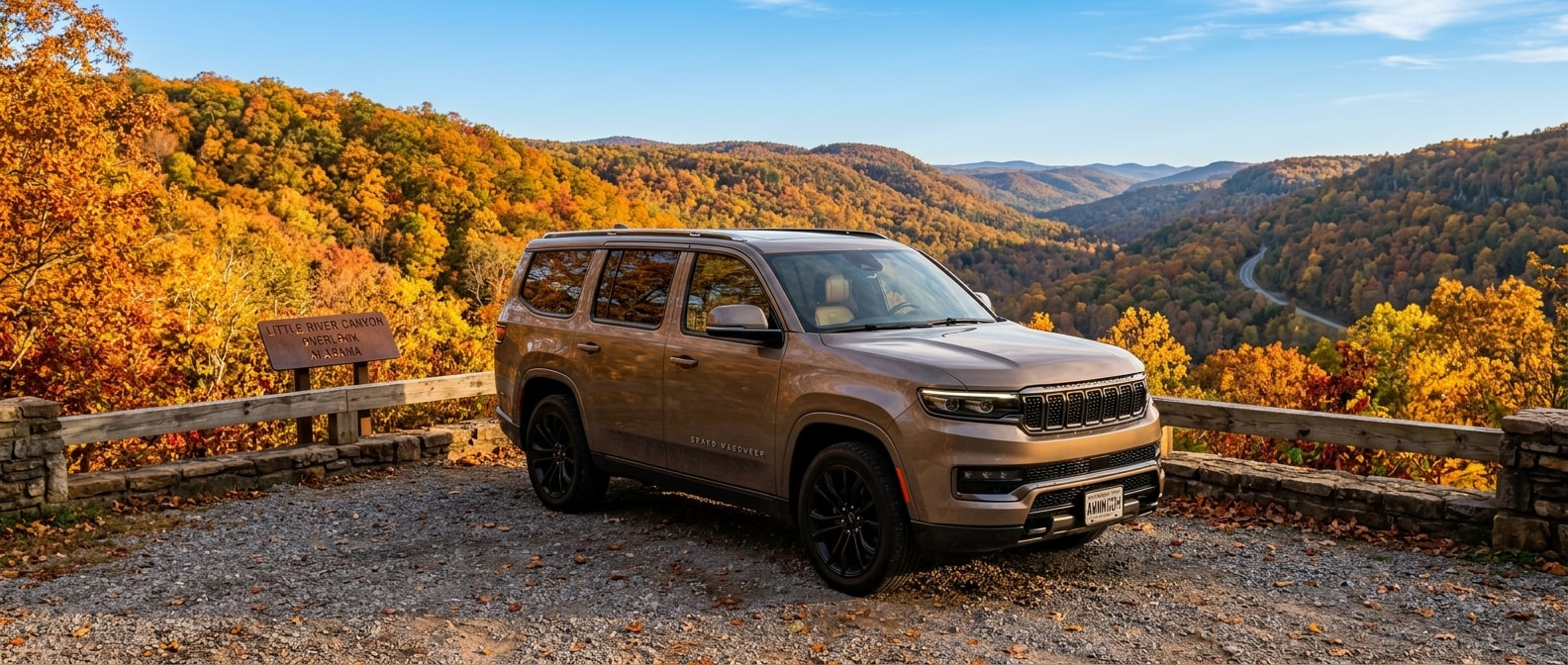
Central Alabama gets around 70 to 80 thunderstorm days per year, per the National Weather Service Birmingham office. Those storms aren't a weather footnote. They're the operating environment for your commute on I-20 and I-59, and they're exactly the conditions the 2026 Dodge Durango's safety systems are designed to work in.
The 2026 Dodge Durango comes standard with Electronic Stability Control, Roll Stability Control, 4-wheel ABS with front and rear vented disc brakes, Blind Spot Monitoring with Rear Cross Path Detection, Advanced Brake Assist with Ready Alert Braking, and rain-sensing wipers on every trim from the GT up. What this post explains is what each of those systems actually does in wet conditions, where the trim-level decisions matter, and what no system can do for you no matter how well-specced the Durango is. That covers the short answer.
How Do the Durango's Core Wet-Weather Systems Work, Exactly?
The Durango's wet-weather systems work by comparing where you're steering against where the SUV is actually heading, then stepping in to close the gap, and the one distinction worth getting straight is that Electronic Stability Control isn't the same thing as traction control. Traction control limits wheelspin during acceleration. Electronic Stability Control detects when the vehicle's actual direction of travel diverges from where the steering wheel is pointed, then applies brake pressure to individual wheels to bring them back into alignment. The system acts fast. Roll Stability Control is a separate but related system that monitors lateral G-forces and intervenes before a high-center-of-gravity SUV reaches a rollover threshold. Dodge lists both as standard on the 2026 Durango, working together with the ABS.
The Advanced Brake Assist with Ready Alert Braking is worth naming specifically. When the system detects a rapid release of the accelerator (which often signals an emergency stop), it pre-pressurizes the brake calipers. So when your foot hits the brake pedal, there's no delay in hydraulic response. On wet pavement, that pre-staging matters.
Rain-sensing wipers adjust sweep speed on their own as rainfall intensity changes. Sounds like a small quality-of-life feature, and it is one. On a fast-moving summer cell that can drop half an inch in under 15 minutes (and Birmingham gets those), manual wiper adjustment is one more thing demanding your attention when your attention should be on the road.
Where Do You Actually Need These Systems on I-20 and I-59?
You'll need these systems most in the spots where the road bends and drains at the same time, and on this commute that means Malfunction Junction ahead of anywhere else, the interchange where I-20, I-59, and I-65 converge downtown with its banked ramps and low points that pool water during heavy rain. You're entering or exiting a curve, your lane is narrowing, and your speed is already compressed. That's exactly the condition where Electronic Stability Control earns its existence, a slight oversteer in a sweeping wet ramp corrected before you even register it.
The other stretch that warrants attention is the grade change entering Birmingham from the east on I-20. The terrain through Jefferson County rolls, and wet grades behave differently from flat wet pavement. Hill Hold Control, standard on the Durango, holds brake pressure for about two seconds after you release the brake pedal on an incline. That matters in stop-and-go rain traffic on a hill, where rolling back into the car behind you becomes a real possibility.
The 2026 Dodge Durango's Electronic Stability Control, Roll Stability Control, and Advanced Brake Assist with Ready Alert Braking are all standard equipment on every GT trim and above, per Dodge.
Which Trim Gives You the Full Wet-Weather Safety Package?
Every Durango trim ships the identical full wet-weather safety stack, so the safety package itself isn't where the trims actually diverge, and the tradeoff worth understanding before you configure one is drivetrain, because all-wheel drive doesn't come along until you step past the base GT.
| Safety Feature | GT (Base) | GT HEMI / GT Plus+ | R/T and Above |
|---|---|---|---|
| Electronic Stability Control | Standard | Standard | Standard |
| Roll Stability Control | Standard | Standard | Standard |
| 4-Wheel ABS + Vented Disc Brakes | Standard | Standard | Standard |
| Blind Spot Monitoring + Rear Cross Path | Standard | Standard | Standard |
| Advanced Brake Assist / Ready Alert Braking | Standard | Standard | Standard |
| Rain-Sensing Wipers | Standard | Standard | Standard |
| AWD | Not standard (RWD base) | Standard | Standard |
| Forward Collision Warning Plus with Full Stop | Available | Available | Available |
| Lane Departure Warning Plus | Available | Available | Available |
| Adaptive Cruise Control with Stop | Available | Available | Available |
The base GT with RWD is where the conversation gets pointed. On dry pavement, RWD in a vehicle this size is completely manageable. On a wet I-20 exit ramp at 55 mph in a summer storm, AWD gives the Durango four points of grip instead of two. AWD becomes standard starting with the GT HEMI and every trim above it, per Dodge. If you're buying a Durango specifically because you drive this corridor in the rain regularly, that's the trim-level decision that matters most.
The Forward Collision Warning Plus with Full Stop, Lane Departure Warning Plus, and Adaptive Cruise Control with Stop are available across trims, not standard. The Alabama Law Enforcement Agency advises drivers to turn off adaptive cruise control in rain and icy conditions, and that's sound practice. These systems assist in clear conditions. In heavy rain, your own judgment about following distance and lane position remains the primary tool.
Wet-weather caution: The Alabama Law Enforcement Agency recommends against using adaptive cruise control and lane-keeping assist in rain. These features are useful in clear conditions but can behave unexpectedly when sensors are wet or visibility is reduced. Set them manually to weather-appropriate speeds and distances instead.
How Does the Durango Handle the Pooling Water at Malfunction Junction?
The Durango handles the pooling water at Malfunction Junction better than most SUVs its size, but the electronics only do their part if you do yours, so here's the checklist we'd hand someone before a first rainy rush-hour run on I-20/59. Print it, then use it on the drive.
- [ ] Check tire tread depth before wet-weather season. The Durango's ABS works on the assumption that tires have adequate contact patch. Worn tread reduces that contact regardless of the electronics.
- [ ] Set following distance to at least four seconds in rain, not the standard two. Stopping distance on wet pavement increases sharply compared to dry.
- [ ] Disable adaptive cruise control in active rain. Radar sensors can misread wet conditions.
- [ ] Slow before the ramp, not on it. The banked curves at Malfunction Junction are where lateral forces combine with wet pavement. ESC helps you recover, it won't replace entry speed.
- [ ] Let rain-sensing wipers do their job. Resist overriding them by hand unless visibility truly requires it.
- [ ] Check tire pressure. Underinflation causes heat through sidewall flexion, which degrades wet-road traction over time before any warning sign appears.
- [ ] Turn on headlights in rain. Alabama law requires it. The Durango's automatic headlights handle this, but verify yours are set to Auto rather than On or Off.
Plan Your Rainy Commute in the Durango This Way
Plan your rainy commute around what the Durango already gives you standard and the one thing it still makes you choose, because the 2026 Dodge Durango brings a genuinely comprehensive standard safety stack to every trim and hands you all-wheel drive only as a trim decision. Electronic Stability Control, Roll Stability Control, ABS, Advanced Brake Assist, Blind Spot Monitoring, and rain-sensing wipers are all there before you add a single option. The real decision for Birmingham commuters is AWD, and if you're regularly on I-20 or I-59 in wet weather, we'd steer you toward the GT HEMI or above where AWD is standard rather than an add-on consideration.
Browse our current Durango inventory to see which trims are on the lot right now, and our team can walk you through exactly which packages add the available lane and collision systems. If you're weighing the Jeep Grand Cherokee as an alternative (also a three-row-capable option with a strong wet-weather ADAS stack), we carry both and we're happy to put them side by side, whichever way you're leaning. The financing application is online if you're ready to move.
Your tire condition, following distance, and entry speed on those wet ramps are the variables the Durango can't control for you. The safety tech is solid.
By the Hallmark Chrysler Dodge Jeep Ram Team | September 2026
Frequently Asked Questions
Does the 2026 Dodge Durango have AWD as standard equipment?
Not on every trim. AWD is standard on the GT HEMI, GT HEMI Plus, GT HEMI Premium, R/T, R/T Plus, R/T Premium, SRT Hellcat, and SRT Hellcat Jailbreak, per Dodge. The base GT trim is available with rear-wheel drive, though you can add AWD. For regular wet-weather commuting on Birmingham's highway interchanges, we'd recommend starting at a trim where AWD is already included.
Are the Durango's electronic safety systems useful in Birmingham's summer thunderstorms, or just for ice and snow?
They're built for wet pavement, not just cold weather. Electronic Stability Control activates whenever the vehicle's actual path diverges from the steered path, whether that's caused by ice, rain, or a sudden evasive maneuver on a dry road. On wet pavement at highway speed, the system responds the same way it would in ice. The difference is that wet pavement still gives you some grip to work with, so the correction is usually more subtle. The rain-sensing wipers and Ready Alert Braking come in handy during the fast-building summer cells that roll through central Alabama.
Should I use adaptive cruise control on I-20/59 when it's raining?
Our team follows the same guidance the Alabama Law Enforcement Agency publishes, turn it off in active rain. Radar-based systems like adaptive cruise control and lane-keeping assist can behave unpredictably when sensors are wet or when visibility drops in a heavy cell. Use manual speed management and set your following distance yourself in those conditions. The Durango's adaptive cruise control is a useful highway feature, but rainy I-20 at rush hour isn't the right environment for it.
Categories:
Social